







Knee Ligament Reconstruction ACL Surgery
ACL reconstruction is an expert-led operation to restore knee stability using advanced graft techniques and suspension fixation, pioneered by Mr. Kenan Dehne for elite recovery outcomes.
ACL Ligament
Reconstruction
Restore stability and confidence after sports injuries. Mr. Dehne uses modern surgical techniques for optimal graft placement and accelerated rehabilitation protocols.
Sports Injury Focus
Tailored surgery for athletes, focusing on dynamic stability and rapid return to competitive play.
Modern Grafting
Latest evidence-based techniques for graft selection and tensioning to ensure long-term graft survival.
Fast Recovery
Early mobilization protocols to prevent muscle atrophy and ensure a quicker return to daily activities.
Minimally Invasive
Advanced arthroscopic approach resulting in smaller incisions, less pain, and reduced scarring.
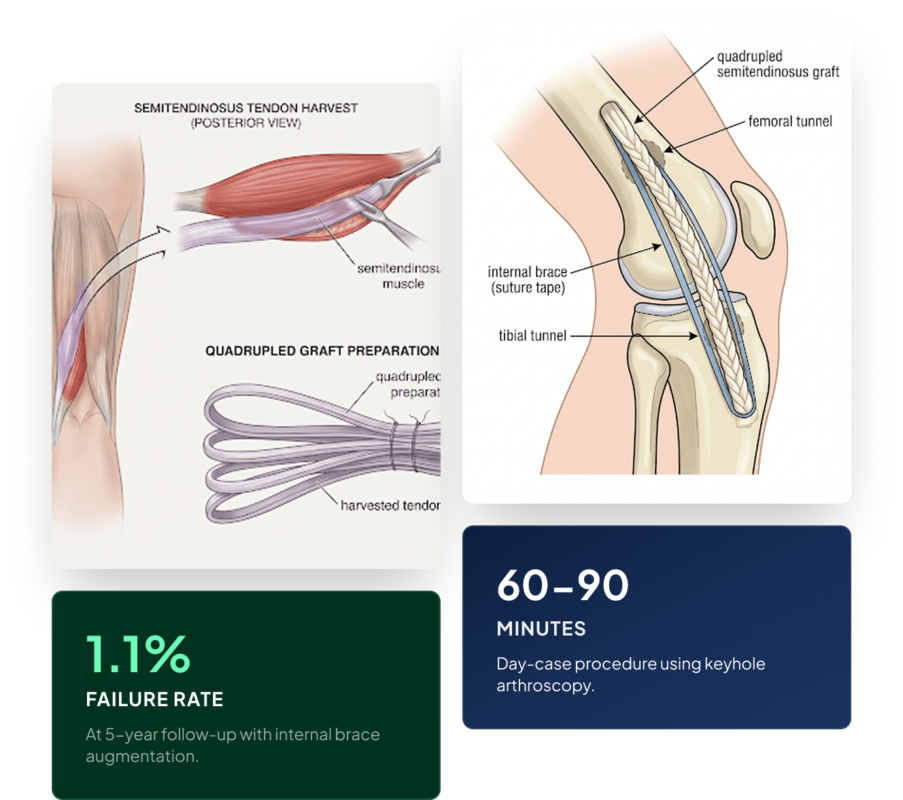
Quadrupled Semitendinosus Graft
with Internal Brace

The Graft: Quadrupled Semitendinosus
The hamstring tendon is folded four times to create a robust graft bundle. Key advantages include reduced donor-site morbidity and preservation of hamstring strength.

Internal Brace: Suture Tape Augmentation
A high-strength 2.0mm FiberTape acts as a 'seatbelt' for the new ligament, sharing the load and protecting it during the critical 'ligamentisation' healing phase.
-
Evidence Based Success
“Wilson et al. (2023) demonstrated a remarkably low failure rate of only 1.1% over 5 years—significantly lower than the 5-15% revision rates for standard ACL reconstruction.”
The ACL’s Role
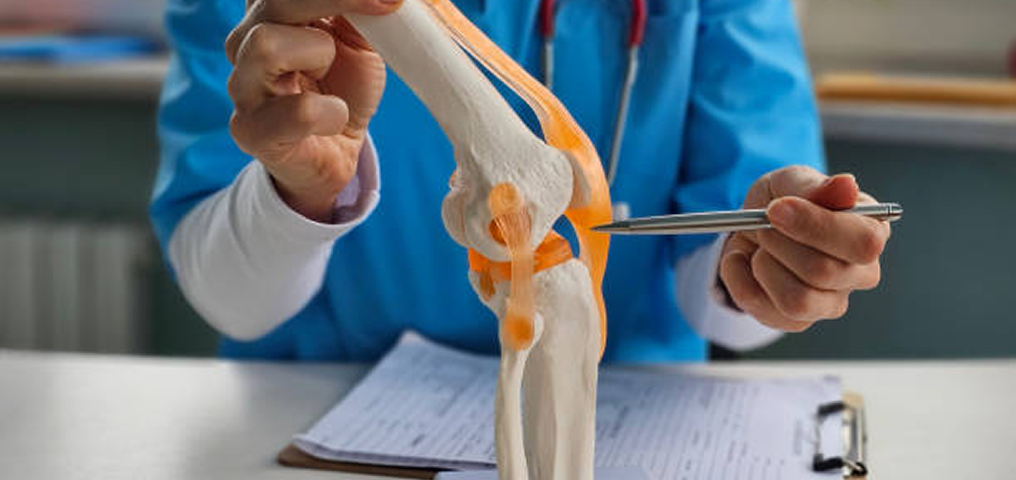
The ACL is a strong band of tissue that runs diagonally through the center of the knee, connecting the femur to the tibia. It is the primary restraint against forward translation and critical for rotational stability during activities like pivoting or sudden changes of direction.
Anterior Cruciate (ACL)
Prevents the tibia from sliding forward and controls rotational stability.
Posterior Cruciate (PCL)
Prevents the tibia from sliding backward during movement.
Medial Collateral (MCL)
Stabilizes the inner side of the knee against lateral forces.
Lateral Collateral (LCL)
Stabilizes the outer side of the knee joint.
ACL Rehabilitation Recovery
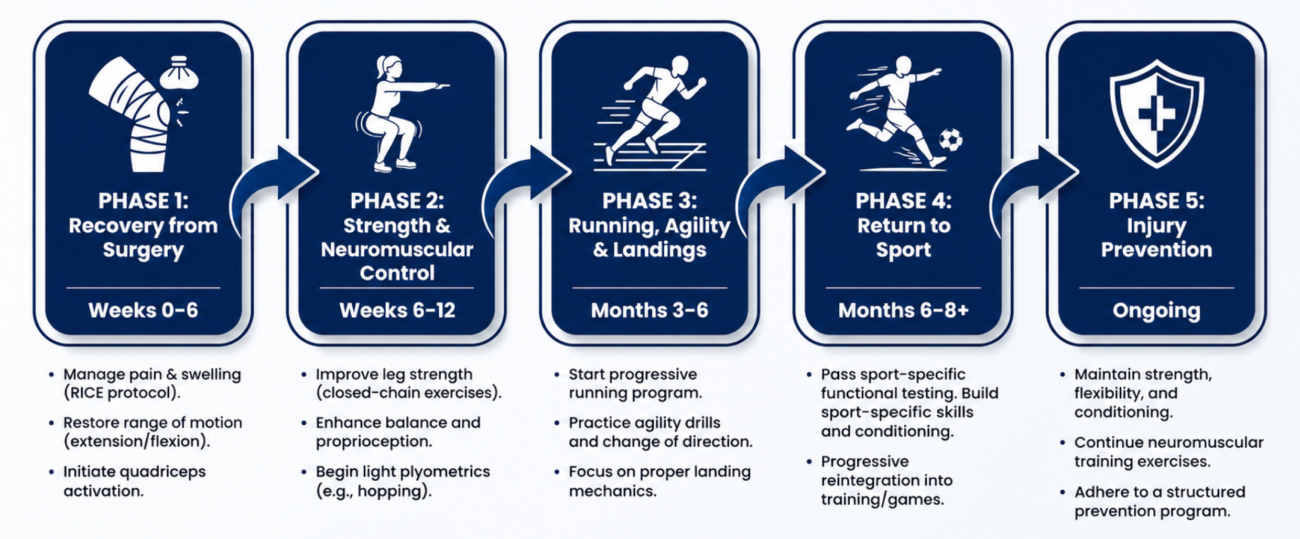
Rehabilitation is criterion-based, not time-based. Progress is achieved by meeting specific functional milestones, ensuring total safety at every phase.
PHASE 1 (WEEKS 0-2)
Recovery from Surgery
-
Full knee extension (0°)
-
Reduce swelling
-
Independent straight-leg raise
PHASE 2 (WEEKS 2-12)
Strength & Control
-
Full range of motion
-
Single-leg balance
-
Leg press at 1.5x body weight
PHASE 3 (MONTHS 3-6)
Running & Agility
-
Straight-line running
-
Change-of-direction drills
-
Hop testing (>90% symmetry)
PHASE 4 (MONTHS 6-12)
Return to Sport
-
Full sport-specific training
-
Match fitness restoration
-
Pass MRSS 2.0 scoring
Frequently Asked Questions
Our FAQs cover consultations, treatments, referrals, recovery, and appointments helping you find the information you need before your visit.
01 How long until I can return to sport?
The time to return to sport depends on the type of injury, the treatment you receive, and your individual recovery. Some patients can resume light activities within a few weeks, while returning to high-impact sports after procedures such as ACL reconstruction or joint replacement may take several months. Mr. Kenan Dehne will provide a personalised rehabilitation plan and advise when it is safe to return to your chosen sport.
02 When can i drive?
The time it takes to return to driving depends on the type of surgery or treatment you have received, your recovery, and which leg was affected. You should only drive when you can safely control the vehicle, perform an emergency stop comfortably, and are no longer taking medication that could impair your ability to drive. Mr. Kenan Dehne will advise you when it is safe to resume driving based on your individual recovery.
03 WIll my insurance cover this?
Most major private health insurance providers cover eligible consultations, investigations, and surgical procedures, subject to the terms of your policy. We recommend contacting your insurer before treatment to confirm your level of cover, obtain any required pre-authorisation, and check whether there are any excess charges or exclusions.
04 What happens after my consultation?
After your consultation, Mr. Kenan Dehne will discuss your diagnosis and recommend the most appropriate treatment plan. Depending on your condition, this may include further imaging, physiotherapy, injections, or surgery. If treatment is required, our team will explain the next steps, arrange any necessary appointments, and support you throughout your care journey.